Agentic Development Platforms for Non-Technical Users: Build MVPs Fast, Go Professional for Production
Agentic development platforms let non-technical founders, operators, and domain experts turn an idea into a working MVP in hours instead of months. They are ideal for testing and validation — but a production-ready commercial app that handles real users, payments, and data still needs professional development. Here's how to use each stage well.
The Shift: From Months of Waiting to Minutes of Building
Not long ago, having an app idea meant finding a developer, writing specs, waiting for designs, reviewing code, and spending weeks or months before you saw a first working version. Today, agentic development platforms compress that first draft dramatically. A founder, business owner, freelancer, finance professional, consultant, teacher, or operations manager can describe an idea in plain language and generate the first version of an application.
That is genuinely powerful — but using these platforms well means understanding what they are for. They are excellent for testing ideas, building MVPs, creating prototypes, validating workflows, running demos for customers or investors, and discovering which features actually matter. For a production-ready commercial application — one handling real users, real payments, real customer data, business-critical processes, or regulatory requirements — you should bring in professional developers or an experienced implementation team.
Put simply: use agentic development platforms to test your MVP; use professional services to build production-ready applications. LogicMint helps you move from idea to MVP quickly, and when the idea is ready for serious internal or commercial use, LogicMint Professional Services — or any qualified development partner — can make it secure, scalable, compliant, and production-ready.
What Are Agentic Development Platforms?
Agentic development platforms are AI-powered systems that understand your instructions, generate application screens, create workflows, suggest features, write code, and improve designs to help you build software faster. They are "agentic" because they do not just answer questions — they perform a series of development tasks like an assistant. Say:
Create a customer-support ticketing app where users raise tickets, admins assign them, and agents update ticket status.
…and the platform can produce login screens, forms, dashboards, tables, user roles, basic workflows, sample data, and UI layouts — plus suggestions for what to improve. You do not need to know how to code to start; you need to know your problem clearly. That is the real unlock. If you're new to the category, our primer on what an AI app builder is is a good starting point.
Why These Platforms Help Non-Technical Users
Non-technical users often have strong business ideas but no way to turn them into software. A school owner wants a homework tracker; a finance manager wants an expense-approval dashboard; a doctor wants an appointment system; a real-estate consultant wants a lead-tracking CRM; a founder wants to test a SaaS idea. Previously, all of them depended on developers even for a first version.
With an AI app builder or idea-to-app platform, they can build that first working version themselves — gaining speed, clarity, and confidence. Instead of explaining an idea in words alone, they can show a working MVP. That changes every conversation that follows.
What Is an MVP?
MVP stands for Minimum Viable Product — the smallest useful version of your application. It is not the final product and not the polished commercial version; it is the first version that proves whether your idea works. For a school homework app, an MVP might include only: a teacher creates homework, a parent views it, a parent updates completion status, and a teacher reviews progress.
That is enough to test the idea. The MVP deliberately leaves out fees, transport tracking, exam results, attendance, chat, an AI tutor, a mobile app, analytics, and payments. It solves the main problem first — and that is exactly what agentic platforms do well. (We cover this in depth in how to build a SaaS MVP with AI.)
Agentic Platforms Are Built for MVP Testing
These platforms shine when you want to quickly test whether an idea makes sense. A small MVP helps you answer the questions that actually determine success: Will users understand the app? Is the workflow practical? Are the screens useful? Are important fields missing? Does it solve a real problem? Will customers care? Is it worth investing more?
Instead of spending heavily upfront, you build a small MVP and test it. A business owner can show a basic CRM to the sales team; a school owner can trial a homework app with one class; a consultant can test a client portal with a few clients; a founder can show a SaaS dashboard to investors. You stop guessing and start validating — which is precisely how you reduce risk. The most reliable way to build that MVP is one module at a time, as we explain in building an app with small prompts.
An MVP Is Not a Production-Ready Application
This is the most important point in this article. Think of an MVP as a sample apartment and a production app as a fully approved building where people can safely live. The sample apartment shows the design; before anyone moves in, the real building needs a proper foundation, wiring, water, fire safety, security, approvals, and maintenance.
Software works the same way. An MVP shows how the app works. A production app additionally needs security, performance, sound database design, access control, backups, monitoring, error handling, compliance, testing, deployment planning, documentation, and long-term maintenance. So a non-technical user should never assume an AI-generated MVP is automatically ready for commercial use. It may be useful, impressive, and a strong starting point — but it still needs professional review before serious use. Our guide on whether AI-generated apps are production-ready gives a practical rubric.
Why Commercial Applications Need Professional Support
If an app is only for learning, demos, or idea testing, an MVP may be enough. But once it will be used by real customers, employees, vendors, students, patients, investors, or paying subscribers, the stakes change. A commercial or internal production application must be reliable: it cannot fail randomly, expose user data, lose payment records, produce wrong reports, allow unauthorized access, or break as users grow.
That is why production-ready development benefits from professional services. Experienced developers and consultants handle architecture, database design, security, authentication, user roles, performance, scalability, cloud deployment, testing, data protection, API and payment-gateway integration, monitoring, backup and recovery, compliance, documentation, and maintenance. This is the difference between "the app works in a demo" and "the app is safe for real business use."
What Non-Technical Users Can Build Themselves
There is still a lot you can do on your own with a platform like LogicMint: MVPs, clickable prototypes, internal workflow demos, simple dashboards, forms, admin panels, CRM mockups, booking-app prototypes, school-app workflows, finance-approval flows, sample e-commerce modules, customer-portal demos, and investor demo apps.
These artifacts are valuable. They help you think clearly, explain better, and test faster — and they reduce development cost because you know what you want before hiring a team. Arriving at a professional team with a working MVP, rather than just an idea, gives them a far better starting point.
What Should Be Handled by Professionals
Some parts of an application deserve careful, experienced hands — especially when money, data, privacy, compliance, or business continuity is involved. Bring in professional support for:
- Payment-gateway integration and commercial subscription systems
- Customer-data protection and role-based security
- Production database design and multi-tenant SaaS architecture
- Cloud infrastructure, performance optimization, and large user access
- API and ERP integrations
- Mobile app publishing
- Legal and compliance checks, audit logs, backup and disaster recovery
- Security testing and apps handling financial or sensitive personal data
This does not mean non-technical users cannot build apps — it means using the right tool for the right stage. Use AI to create and validate; use professionals to harden, secure, scale, and launch.
Example: A CRM App
A non-technical business owner can use an agentic platform to build a CRM MVP with lead capture, status tracking, follow-up dates, a sales dashboard, basic reports, and customer notes — enough to test with a small sales team and ask whether the fields are useful, the workflow is simple, and the reports are complete.
After testing, the owner may find the real production app needs email integration, WhatsApp reminders, role-based access, manager approval, Excel import, lead-assignment rules, mobile access, secure login, cloud deployment, backups, and an audit trail. At that point the MVP has done its job, and a professional team can convert it into a production-ready CRM. (See how to build a CRM with AI for the module-by-module build.)
Example: A Finance Approval App
A finance professional can generate an expense-approval MVP with a submission form, receipt upload, an approval dashboard, approve/reject actions, status tracking, and a basic summary — testable internally with a small team. For serious use, it may need role-based approvals, department budget checks, ERP integration, accounting entries, tax/GST classification, an audit trail, maker-checker control, notifications, secure document storage, access logs, monthly reporting, and backups. That is no longer just an app screen — it is a business-process system, and it requires professional review and implementation.
Example: An E-Commerce App
An AI app builder can quickly generate an e-commerce MVP — product listing, product details, cart, checkout, order history, admin product management — which is great for testing the idea. A real commercial store additionally needs a secure payment gateway, order and inventory management, tax calculations, shipping integration, a refund process, customer-data security, fraud checks, notifications, performance optimization, admin controls, analytics, and legal policies. A demo store can be generated fast; a production e-commerce business needs professional implementation. Our guides on building an e-commerce store with AI and adding payments safely cover the details.
Why This Matters for Non-Technical Founders
Seeing an AI-generated app is exciting — it means the idea is becoming real. The risk is assuming "the app is generated, so it's ready to sell." That is not always true. The code may need cleanup, the database may need redesign, security may need strengthening, the user journey may need work, hosting must be arranged, the payment flow must be compliant, backups must exist, and it must be tested across devices. The right mindset is simple: AI-generated MVP first, professional production build next. That protects your users, your business, and your brand.
The Right Way to Use LogicMint
Use LogicMint as a powerful idea-to-app and MVP-building platform, following this loop: start with your idea, generate a small module, improve it, test the workflow, build the next module, connect the modules, validate the MVP with real users, collect feedback, finalize required features, then move to production development. You don't need to code — but you should know your users, your problem, and your workflow. LogicMint turns that understanding into a working MVP; professional services then turn the MVP into a serious application.
When to Hire LogicMint Professional Services
Consider professional support once your MVP is validated and you want to move toward real use — for example when you want to:
- Launch the app commercially or roll it out to employees internally
- Let customers sign up, collect payments, or store real user data
- Connect third-party APIs, or integrate with ERP/CRM systems
- Publish a mobile app or deploy a scalable cloud setup
- Add proper security, access control, and compliance-ready documentation
- Convert your MVP into a SaaS product with long-term maintenance
The MVP proves the idea; professional services make it reliable.
You Can Use Any Qualified Development Team
LogicMint Professional Services is one option, but you are free to work with any qualified software team, technology consultant, agency, freelancer, or internal IT department. What matters is not who you hire — it is that production applications are reviewed and prepared by professionals before serious use. A good team can take your LogicMint-generated MVP and strengthen the architecture, secure the data, improve the code, deploy it properly, and prepare it for real users. Starting from a tested concept instead of zero saves time and reduces misunderstandings.
MVP Stage vs Production Stage
| Area | MVP stage | Production stage |
|---|---|---|
| Purpose | Test the idea | Run the real business |
| Users | Small test group | Real users or customers |
| Data | Sample or limited | Real business/customer data |
| Security | Basic | Strong and reviewed |
| Design | Functional | Professional and polished |
| Performance | Good enough for a demo | Optimized for real usage |
| Testing | Basic | Proper QA and regression testing |
| Deployment | Demo or staging | Production cloud setup |
| Compliance | Limited | Required where applicable |
| Maintenance | Minimal | Ongoing support |
| Best handled by | User + AI platform | Professional team |
Agentic platforms help you move fast in the MVP stage; professional services help you move safely in the production stage. Both matter — and the journey between them is covered in from prototype to production.
What Makes an Application Production-Ready?
A production-ready application is not simply one that opens in a browser — it must be stable, secure, tested, and maintainable. Concretely, it should have secure authentication, proper permissions, a clean database structure, input validation, error handling, backup and recovery, audit logs, performance optimization, mobile responsiveness, API security, data protection, monitoring, a deployment pipeline, documentation, admin controls, a user-support process, and a scalability plan. For personal testing, an MVP is enough; for business use, production readiness is necessary. Before launch, work through a pre-deployment checklist and a security audit.
AI Reduces Cost — Not Responsibility
AI can cut development time and initial cost, help non-technical users create prototypes, help founders explain ideas, and help teams move faster. What it does not do is remove responsibility. If you launch commercially, you are accountable for user experience, data safety, payments, legal compliance, and service reliability. Treat AI as a powerful builder for the first version, and professionals as the engineers who make the building safe to live in. Both roles matter.
Best Practices for Non-Technical Users
- Start with one clear problem and build only the core workflow first.
- Use small prompts and test each screen as you go.
- Avoid adding too many features early; use sample data during MVP testing.
- Do not collect sensitive real user data in an unfinished app.
- Document what works and what doesn't, and gather feedback from real users.
- Prepare a list of must-have production features, and hire professional support before launch.
Common Mistakes to Avoid
- Trying to build the entire app in one prompt.
- Assuming the first generated version is final.
- Adding payment features too early, or using real customer data in an unfinished MVP.
- Skipping security review and ignoring mobile responsiveness.
- Not testing user permissions or validating business workflows.
- Launching publicly without QA, or expecting AI to replace all professional development.
Use AI wisely: move fast, but do not move blindly.
How LogicMint Supports the Full Journey
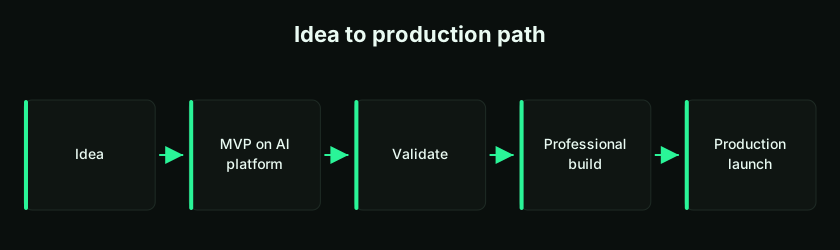
LogicMint can support you across stages. At the idea stage it helps convert a concept into a structured application flow. At the MVP stage it generates screens, dashboards, forms, and workflows. At the improvement stage it helps refine modules and connect features. At the production stage, LogicMint Professional Services can help convert the MVP into a production-ready application. That gives you a practical path: idea → MVP → validation → professional build → production launch → continuous improvement.
Key takeaways
- Agentic development platforms let non-technical users go from idea to MVP in hours — ideal for testing and validation.
- An MVP is not a production app: it proves the idea but lacks the security, scale, compliance, and maintenance real users require.
- Build and validate with AI; harden, secure, and launch with professionals — LogicMint Professional Services or any qualified team.
- Bring in professional support before you collect payments, store real data, integrate APIs, or launch commercially.
- AI reduces cost, not responsibility — you remain accountable for data safety, payments, and reliability.
Frequently Asked Questions
What is an agentic development platform?
An agentic development platform is an AI-powered platform that helps users generate, improve, and manage software development tasks. It can create screens, workflows, dashboards, forms, and application logic based on your prompts.
Can non-technical users build apps using agentic development platforms?
Yes. Non-technical users can build MVPs, prototypes, dashboards, forms, and simple workflows using plain-language prompts. You do not need to know coding to start.
Can I launch an AI-generated app directly as a commercial product?
Be careful. An AI-generated app can be a useful MVP, but a commercial application should be professionally reviewed, secured, tested, and deployed before real users rely on it.
What is the difference between an MVP and a production-ready app?
An MVP is the first useful version of an app, used to test an idea. A production-ready app is secure, scalable, tested, monitored, documented, and suitable for real users or commercial use.
When should I hire professional services?
Hire professional services when you want to launch commercially, use the app internally with real users, collect payments, store customer data, integrate APIs, or scale the application.
Can LogicMint help convert an MVP into a production-ready app?
Yes. LogicMint Professional Services can help review, improve, secure, deploy, and scale an MVP into a production-ready application for internal or commercial use.
Can I use another developer or agency instead?
Yes. You can work with LogicMint Professional Services or any qualified software team, agency, freelancer, consultant, or internal IT department. The key point is that production applications need professional review.
Is an AI app builder enough for startups?
It is excellent for creating and testing startup MVPs. Once the startup is ready to launch publicly or serve paying customers, professional development support is strongly recommended.
Why should I not use real customer data in an MVP?
An MVP may not yet have full security, backup, compliance, access control, or error handling. Use sample data until the application is professionally reviewed and prepared for production.
What type of apps can I build as an MVP with LogicMint?
CRMs, booking systems, internal tools, dashboards, finance workflows, school apps, customer portals, e-commerce prototypes, admin panels, and SaaS MVPs.
Agentic development platforms are changing how software gets built, making it possible for non-technical users to go from idea to MVP faster than ever. But speed is not the same as production readiness. Use LogicMint to generate your idea, test your workflow, build your MVP, and validate your concept — and when you're ready for real users, payments, data, or a commercial launch, bring in LogicMint Professional Services or another qualified team. Build fast, validate early, launch safely, and scale professionally. Start from LogicMint or compare plans on the pricing page.