How Freelancers Can Use Idea-to-App Platforms to Improve Productivity and Deliver Cost-Effective Solutions
Freelancers face constant pressure to deliver faster, cheaper, and better. Idea-to-app platforms like LogicMint let you turn a client's idea into a working MVP, dashboard, or internal tool in minutes — so you spend your time on judgment and delivery, not repetitive setup. Here's how to build that into a profitable freelance workflow.
The Freelancer's Squeeze
Clients want faster delivery, better quality, lower cost, professional design, working demos, and quick revisions — all at once. Meanwhile freelancers have to protect their margins, juggle multiple projects, reduce manual effort, and avoid drowning in repetitive work. This is exactly where an idea-to-app platform helps.
An idea-to-app platform lets a freelancer convert a client's idea into a working application prototype, MVP, dashboard, admin panel, workflow, or internal tool using simple prompts. This does not replace freelancers — the opposite is true. Freelancers who learn to use AI app builders and agentic development platforms become more productive, more competitive, and more valuable. Instead of starting every project from zero, you generate the first version, improve it, customize it, and deliver better outcomes at lower cost.
Why Freelancers Need Better Productivity Tools
Freelancing is not only the technical work. You also handle client discussions, requirement gathering, proposals, UI planning, feature breakdown, development, testing, revisions, deployment support, documentation, and maintenance. It adds up fast.
Clients are often unclear about what they want. One says "I need a CRM," when they really need a lead tracker, follow-up dashboard, quotation manager, and sales reporting. Another says "I need an e-commerce app" without knowing whether they need inventory, coupons, shipping, tax, payments, refunds, or admin approval. Freelancers burn hours converting vague ideas into concrete requirements. LogicMint closes that gap: generate a first version quickly, show the client, collect feedback, and refine. A client may not understand a long requirements document — but they always understand a working screen.
What Freelancers Can Build with LogicMint
LogicMint gives freelancers a faster path from idea to a usable software draft — client MVPs, internal business tools, CRM dashboards, booking systems, admin panels, finance workflows, school-management modules, inventory trackers, customer portals, lead-management systems, approval workflows, e-commerce prototypes, and SaaS mockups. Instead of explaining everything through documents and screenshots, you show a working version. That improves client confidence and reduces misunderstanding — the single biggest advantage of the approach.
Use LogicMint Before Writing Full Code
One of the smartest ways to use an idea-to-app platform is during planning and the MVP stage — before full development. If the client wants a CRM, first generate a lead-capture page, lead list, status tracking, a follow-up dashboard, sales summary cards, and a basic manager view. Then show it and ask the questions that matter: Is this what you expected? Are the fields correct? Do you need more statuses? Who should see this dashboard? Do you need email or WhatsApp reminders? Do you need Excel export or role-based access?
This early validation saves enormous time. Without it, you might build the wrong thing and spend hours reworking it. The most reliable way to generate that first version is one module at a time — see building an app with small prompts.
Cost-Effective Development Without Cutting Quality
Clients want affordable solutions — but affordable should mean less wasted effort, not lower quality. LogicMint reduces the time freelancers spend on initial layouts, basic forms, dashboard structure, admin panels, common workflows, UI starting points, feature exploration, MVP prep, and client demos. When the first version appears in minutes, you can invest your time where it actually counts:
- Understanding business logic and improving user experience
- Handling edge cases and adding security
- Customizing workflows and testing thoroughly
- Preparing production deployment
Because you're no longer spending days on repetitive starting work, you can offer better pricing while delivering a more practical final solution.
Example: Building a CRM for a Small Business
A small business hires you and says, "We need a system to manage leads and follow-ups." Generate an MVP in LogicMint with a lead-creation form, a status table, follow-up dates, search and filter, a sales dashboard, and basic reports. The client then adds, "We also need lead assignment to sales executives." You refine with a prompt:
Add lead assignment so the manager can assign each lead to a sales executive. Sales executives should only see their assigned leads.
When they ask for reminders, you add a follow-up section showing leads due today and overdue leads. This step-by-step build avoids overbuilding: the client gets exactly what's needed, you save effort, and the project becomes more profitable. Our guide to building a CRM with AI walks the full data model.
Example: Building an Internal Approval App
A company asks for an expense-approval app. In LogicMint you create an employee submission form, a receipt-upload field, a manager approval dashboard, approve/reject actions, status tracking, and a summary report. Based on feedback you then layer in a department filter, monthly budget checks, a finance-approval stage, Excel export, an audit trail, and email notifications. You don't build everything blindly on day one — LogicMint creates the structure quickly, and your professional judgment refines it. See building internal tools with AI for more.
LogicMint Doesn't Remove Freelancer Value
Some freelancers worry AI app builders will reduce demand for their services. The reality is different. Clients still need people who understand requirements, structure workflows, solve business problems, test applications, and deliver production-ready solutions. LogicMint generates a starting point; you add the value:
- Asking the right questions and understanding client pain points
- Choosing the right architecture and cleaning up workflows
- Improving UI/UX, adding integrations, and securing the app
- Testing properly, managing deployment, and providing support
A tool does not replace expertise — it increases the speed of an expert. A freelancer using LogicMint can deliver more projects, serve more clients, and provide better value.
A Practical Freelance Workflow
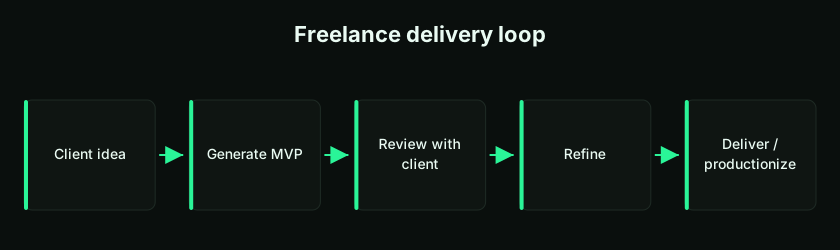
Fold LogicMint into a controlled delivery process: collect the client's basic idea, break it into modules, generate the first module, review the output with the client, improve it using feedback, generate the next module, connect the modules, prepare the MVP, get approval, and then decide whether to productionize. This avoids scope confusion — instead of arguing later about what was expected, you and the client watch the app evolve step by step.
MVP First, Production Later
Be clear with clients about one thing: an AI-generated MVP is not always a production-ready application. The MVP is ideal for testing the idea, showing the workflow, validating features, gathering user feedback, preparing a demo, and estimating final scope. But before commercial or at-scale internal use, review security, database design, authentication, permissions, error handling, performance, hosting, backup, testing, compliance, and the deployment process.
This honesty builds trust. Good freelancers don't overpromise — they help clients understand the difference between a fast MVP and a serious production app. Our deep dives on MVP vs production and from prototype to production are useful to share with clients, and you can bring in professional services for the hardening stage.
Win More Clients with a Working Demo
LogicMint helps with sales, too. Instead of only sending a proposal, show a small working demo. When a client asks for a booking app, generate a booking-flow MVP and say, "Here's a sample of how your booking workflow can work." That instantly creates trust — the client sees action, you look professional, and the discussion becomes practical. A working demo is far more powerful than a long PDF proposal.
Best Use Cases for Freelancers
| Use case | How LogicMint helps |
|---|---|
| CRM apps | Generate lead forms, dashboards, and follow-up flows |
| Booking apps | Create appointment screens and slot management |
| Finance tools | Build approval workflows and reporting dashboards |
| School apps | Create homework, attendance, or parent-communication modules |
| Admin panels | Generate tables, filters, forms, and role-based dashboards |
| E-commerce MVPs | Build product listing, cart, and order workflows |
| SaaS prototypes | Convert startup ideas into demo-ready MVPs |
| Internal tools | Create workflow apps for small businesses |
| Client portals | Generate login, document upload, and status-tracking screens |
Use these as starting points, then customize them for each client. For recurring back-office work, the business automation builder and ready-made app templates can speed things up further.
Best Practices for Freelancers
Keep a disciplined approach. Don't generate the full app in one prompt, accept the first version blindly, use real client data during early testing, promise production readiness without review, skip security and testing, ignore mobile responsiveness, or add too many features too early. Instead: start small, build one module, improve it, review with the client, document feedback, connect modules carefully, test each workflow, and move to production only after a proper review. This protects both you and the client.
Key takeaways
- Idea-to-app platforms make freelancers faster, not obsolete — they remove repetitive setup so you focus on judgment and delivery.
- Use LogicMint to validate requirements early with a working MVP instead of long documents.
- Deliver cost-effective solutions by cutting wasted effort, not quality.
- Win projects with a working demo — more persuasive than any PDF proposal.
- Be honest about MVP vs production, and review security and deployment before real use.
Frequently Asked Questions
Can freelancers use LogicMint to build apps for clients?
Yes. Freelancers can use LogicMint to create MVPs, prototypes, dashboards, admin panels, and workflow applications for clients.
Does LogicMint replace freelancers?
No. LogicMint helps freelancers work faster. Freelancers still add value through requirement understanding, customization, testing, deployment, security, and client management.
Can freelancers deliver production-ready apps using LogicMint?
LogicMint can help create a strong starting point or MVP. For production-ready apps, freelancers should professionally review, test, secure, and deploy the application.
How can freelancers reduce project cost using LogicMint?
Freelancers can reduce time spent on repetitive setup, basic UI creation, forms, dashboards, and prototypes. This allows them to offer more cost-effective solutions while maintaining quality.
What kind of client apps can freelancers build with LogicMint?
Freelancers can build CRM apps, booking systems, school apps, finance tools, e-commerce prototypes, internal dashboards, client portals, and SaaS MVPs.
Freelancers who use idea-to-app platforms become faster, smarter, and more competitive. LogicMint helps you convert client ideas into working MVPs, reduce repetitive effort, and deliver cost-effective solutions — but the best results come from combining AI speed with human judgment. LogicMint generates the first version; you bring the business understanding, customization, testing, and delivery quality. Start from LogicMint, explore what it can generate on the features page, or compare plans on pricing.