Can You Trust AI Agents? Risks, Mistakes, and Keeping a Human in the Loop
AI agents can save real time — but they aren't infallible. They can be confidently wrong, lose track of context, and take actions that look reasonable yet are wrong in your situation. This honest guide covers where agents fail, why, and how to use them safely by keeping a human in the loop.
The Short Answer: Trust, but Verify
Can you trust an AI agent? For low-risk, well-defined tasks under supervision — yes, they're genuinely useful. For anything involving money, customer data, or irreversible actions — trust them the way you'd trust a fast but junior assistant: give clear limits, review their work, and stay ready to step in. The goal isn't blind trust or blanket avoidance; it's calibrated trust. If you're new to agents, start with what are AI agents?
Where AI Agents Go Wrong
Understanding the failure modes is what lets you use agents safely. The common ones:
- Hallucinations. Agents can generate plausible but incorrect information — and state it with confidence.
- Overconfidence. They often fail to signal uncertainty, sounding just as sure when they're wrong as when they're right.
- Lost context. In long tasks, earlier details can drop out, causing the agent to contradict itself or forget the original goal.
- Wrong-in-context actions. An action can look rational on the surface but be completely wrong for your specific situation.
- Cascading failures. One early mistake can flow through a multi-step workflow, so a small error becomes a big one.
- Opacity. Many agents don't explain their reasoning, making it hard to judge whether a conclusion is well-founded.
The Human Risks: Overreliance and Misplaced Trust
Some of the biggest risks aren't technical — they're about how people relate to agents. Because agents communicate in fluent, human-like language, it's easy to overestimate what they can do. Overreliance happens when people accept an agent's recommendation without the scrutiny it deserves. Worse, a confident, well-worded explanation increases trust even when the explanation is wrong. The lesson: judge an agent by whether its output is correct and verifiable, not by how convincing it sounds.
Why More Autonomy Means More Risk
A single agent doing one narrow task is easy to supervise. As you move toward more autonomous, multi-step agentic AI, the system makes more decisions across more systems — and the blast radius of a mistake grows. In regulated areas like finance or healthcare, an error can mean a compliance violation or mishandled sensitive data. The more an agent can do without asking, the more carefully you should bound what it's allowed to do.
What Makes an AI Agent Trustworthy
You can decide how much to trust an agent by looking for a few safeguards:
| Safeguard | What to look for |
|---|---|
| Signals uncertainty | The agent flags low confidence instead of guessing |
| Explains itself | You can see how and why it reached an output |
| Clear limits | Defined boundaries on what it can do, decide, or recommend |
| No silent escalation | It never quietly expands its own autonomy |
| Easy human override | You can challenge, correct, or disengage at any time |
If an agent can't do these things, keep its scope small and its oversight high.
How to Use AI Agents Safely
Practical habits that keep agents on the right side of trustworthy:
- Start narrow. One well-defined, low-risk task first — expand only once it's proven.
- Draft, don't send. For customer-facing or financial actions, have the agent prepare work for human approval.
- Set hard limits. Define what it must never do without sign-off — refunds, external emails, high-value records.
- Keep a human in the loop. Require escalation for anything uncertain, sensitive, or irreversible.
- Test on safe data. Verify behavior with sample data before real work.
- Review regularly. Spot-check outputs over time; agents can drift as inputs change.
These mirror the safe-use principles we apply to AI-built software in precautions when using AI to build apps.
Where the Line Should Be
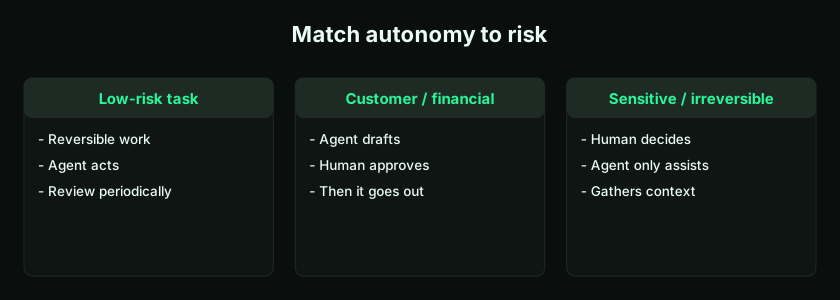
A simple way to decide how much autonomy to grant: match it to the cost of being wrong.
| If the task is… | Then… |
|---|---|
| Low-risk and reversible (sorting, drafting, summarizing) | Let the agent act, review periodically |
| Customer-facing or financial | Agent drafts; a human approves before it goes out |
| Sensitive, regulated, or irreversible | Human decides; agent only assists and gathers context |
The Bottom Line for Non-Technical Users
AI agents are worth using — they remove real drudgery. But treat them as capable assistants, not autonomous decision-makers. Give them clear jobs and clear limits, verify their work where it matters, and keep the ability to step in. Used that way, you get the speed without inheriting the risk. When agents live inside software you're building, the same rule applies: for anything headed to real users or real data, review before you rely — a principle we stress in are AI-generated apps production-ready?
Key takeaways
- Aim for calibrated trust — useful for low-risk tasks, closely supervised for high-stakes ones.
- Know the failure modes: hallucinations, overconfidence, lost context, cascading errors, opacity.
- Beware overreliance — a convincing explanation isn't proof the output is correct.
- Trustworthy agents signal uncertainty, explain themselves, respect limits, and allow easy override.
- Match autonomy to the cost of being wrong, and keep a human in the loop for money, customers, and irreversible actions.
Frequently Asked Questions
Can I trust AI agents to work on their own?
For low-risk, well-defined tasks under supervision, yes. For anything involving money, customer data, or irreversible actions, keep a human in the loop and review the agent's work.
What are the main risks of AI agents?
Hallucinations (confident but wrong answers), overconfidence, lost context in long tasks, actions that are wrong in your specific situation, cascading failures across steps, and a lack of transparency about their reasoning.
Why is overreliance on AI agents dangerous?
Because agents sound fluent and confident, people tend to overestimate them and accept recommendations without scrutiny. A convincing explanation can increase trust even when it's wrong — so verify outputs, don't just trust the tone.
How do I make an AI agent safer to use?
Start with one narrow task, have it draft rather than send for sensitive actions, set hard limits, require human escalation for uncertain or irreversible cases, test on safe data, and review outputs regularly.
Does more autonomy mean more risk?
Yes. The more decisions an agent makes across more systems, the larger the impact of a mistake. Bound autonomy tightly for high-stakes or regulated work.
How much should an AI agent be allowed to do?
Match autonomy to the cost of being wrong: let it act on low-risk, reversible tasks; have it draft for customer-facing or financial actions; and keep humans deciding on sensitive or irreversible ones.
You can trust AI agents — carefully. Understand where they fail, give them clear jobs and firm limits, verify what matters, and always keep a way to step in. That calibrated approach lets a small team capture the speed of automation without handing over judgment. To put agents to work responsibly inside real apps, explore LogicMint or read how to build an AI agent without coding.