Agentic AI vs AI Agents: What's the Difference?
The terms sound alike, but they're not the same. An AI agent handles a single, well-defined task. Agentic AI is the bigger system that plans, reasons, and coordinates many agents and tools to reach a broader goal. This guide explains the difference in plain language, with examples and guidance on when each fits.
The One-Sentence Answer
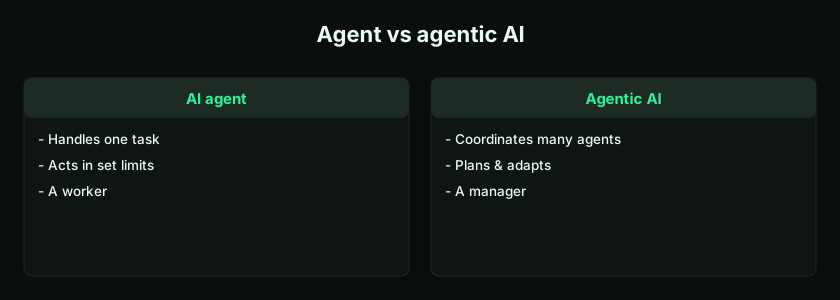
An AI agent is a task-doer. Agentic AI is an orchestrator. An AI agent carries out a specific action when it's needed; agentic AI takes a high-level goal, figures out which tasks are required, sequences them, and directs multiple agents and tools to achieve the outcome. Agents are the workers; agentic AI is the manager coordinating them. (If you're brand new to the topic, start with what are AI agents?)
Side-by-Side Comparison
| Dimension | AI agent | Agentic AI |
|---|---|---|
| Scope | One specific, well-defined task | A broad, multi-step goal across systems |
| Role | Performs an action | Plans and coordinates many actions |
| Autonomy | Acts within set parameters | Pursues goals and adapts in real time |
| Decision-making | "Do this task" | "Achieve this outcome" |
| Analogy | A worker | A manager directing workers |
| Best for | Simple, repeatable tasks | Complex, evolving problems |
What an AI Agent Is
An AI agent is designed to perform a specific, predefined task within set boundaries. It reads an input, applies its reasoning, uses a tool if needed, and produces a result. A support agent might answer a customer query from a knowledge base or pull a record from a database when asked — but it won't proactively investigate an unrelated problem or launch a new initiative on its own. Its strength is doing one job reliably.
What Agentic AI Is
Agentic AI operates at a higher level. Instead of executing one predefined task, it takes an objective, decides what needs to happen, and orchestrates multiple agents, data sources, and tools to get there — adjusting as new information arrives. It doesn't just respond to "do this task" commands; it understands "achieve this outcome" objectives and works out how to reach them. That means planning, sequencing, and course-correcting across a whole workflow rather than a single step.
An Example That Shows the Difference
Imagine handling a customer complaint about a late order.
- An AI agent might do one piece: look up the order status when asked, and reply with the delivery date.
- Agentic AI handles the whole outcome: it checks the order system, confirms the delay, updates the customer, opens a ticket, notifies the operations team, offers a resolution within set limits, and logs the interaction — coordinating several agents and tools without being told each step.
Same starting point, very different level of independence and scope.
How They Work Together
These aren't competing choices — they're layers. Agentic AI is what turns a collection of individual agents into a complete, coordinated workflow. The agents perform the individual tasks; the agentic layer decides which agents to use, in what order, and how to connect their results. In practice, most useful "agentic" systems are made of several focused agents working under a coordinating brain.
Which One Do You Actually Need?
For a non-technical user, the practical guidance is simple:
- Choose a single AI agent when the job is one clear, repeatable task — sorting emails, qualifying leads, drafting a specific type of reply. Start here; it's easier to build, test, and trust.
- Move toward agentic AI when the problem is complex and evolving — a multi-step process that spans several systems and needs decisions made along the way.
The most reliable path is to start with one focused agent, get it working well, and only combine agents into a larger agentic workflow once each piece is proven. That mirrors the "build small, then connect" discipline we recommend for apps in building with small prompts.
Why the Distinction Matters for Trust and Risk
The more autonomy a system has, the more oversight it needs. A single agent doing a narrow task is easy to supervise. Agentic AI, which makes more decisions across more systems, carries more risk if it goes wrong — a small mistake can cascade through a workflow. Whichever level you use, insist on clear limits, visible reasoning, uncertainty signals, and an easy way for a human to step in. We cover this in can you trust AI agents?
How This Connects to Building Software
Both agents and agentic workflows can live inside the apps you build. With an idea-to-app platform like LogicMint, you can generate an app and embed an agent to handle a task within it, or connect several to automate a broader process. Creators also package agents and templates on the LogicMint marketplace. Understanding the agent-vs-agentic distinction helps you scope these projects realistically — start with one capable agent, then grow into coordinated workflows.
Key takeaways
- An AI agent performs one specific task; agentic AI plans and coordinates many agents and tools toward a broader goal.
- Agents act on "do this task"; agentic AI acts on "achieve this outcome" with more autonomy.
- They're layers, not rivals — agentic AI turns individual agents into a complete workflow.
- Start with a single focused agent for repeatable tasks; grow into agentic workflows for complex, evolving problems.
- More autonomy means more oversight — clear limits and a human in the loop matter more as scope grows.
Frequently Asked Questions
What is the difference between agentic AI and AI agents?
An AI agent handles a single, well-defined task. Agentic AI is the higher-level system that plans, reasons, and coordinates multiple agents and tools to achieve a broader, multi-step goal.
Is agentic AI just multiple AI agents?
Roughly, yes — agentic AI often coordinates several focused agents, along with data sources and tools, and adds the planning and sequencing that connects their work into a complete workflow.
Which is more autonomous?
Agentic AI. An AI agent acts within predefined parameters, while agentic AI pursues goals, makes decisions, and adapts to new information in real time.
Which should a beginner start with?
Start with a single AI agent for one clear, repeatable task. It's easier to build, test, and trust. Move toward agentic AI once individual agents are proven and the problem is genuinely multi-step.
Does more autonomy mean more risk?
Yes. The more decisions a system makes across more systems, the greater the impact if it errs. Both agents and agentic AI need clear limits, visible reasoning, and easy human intervention.
Can AI agents and agentic AI live inside an app?
Yes. With an idea-to-app platform you can embed a single agent to handle a task, or coordinate several into an agentic workflow that automates a broader process.
The difference between agentic AI and AI agents comes down to scope and autonomy: agents do specific tasks, while agentic AI orchestrates many of them toward an outcome. For most people the smart move is to start with one capable agent, prove it, and grow into coordinated workflows only as needed. To see how agents fit into real software, explore LogicMint, read how to build an AI agent without coding, or browse the marketplace.