What Are AI Agents? A Plain-English Guide for Non-Technical People
An AI agent is software that can take a goal, decide what steps to take, use tools to get things done, and act — not just answer a question. This guide explains what AI agents are in plain language, how they differ from a chatbot, where they help, and how a non-technical person can start using them.
The Simple Definition
An AI agent is a program that can understand what you want, figure out the steps needed, take action, and learn from the result — often with little or no supervision along the way. The key word is act. A regular AI tool answers a question. An AI agent takes a goal and does something about it: it reads information, makes decisions, uses other tools, and completes a task.
Think of the difference between a knowledgeable colleague who tells you how to process an invoice, versus an assistant who actually processes the invoice for you — checking the details, entering the data, flagging anything unusual, and telling you when it's done. The second one is behaving like an agent.
Chatbot vs AI Agent: The Core Difference
Most people first met AI through a chatbot — you type a question, it types back an answer. An AI agent goes further: it can carry out a multi-step task on your behalf.
| Regular chatbot / AI assistant | AI agent |
|---|---|
| Responds to a single question | Pursues a goal across multiple steps |
| Gives you information | Takes action and produces a result |
| Waits for your next message | Decides what to do next on its own |
| Can't use other tools | Can use tools — email, databases, apps, APIs |
| "Here's how to reply to this email" | "I've drafted and filed a reply, and flagged two for you" |
In short: a chatbot talks; an agent does. We compare these categories in detail in AI agents vs chatbots vs automation.
How an AI Agent Works (Without the Jargon)
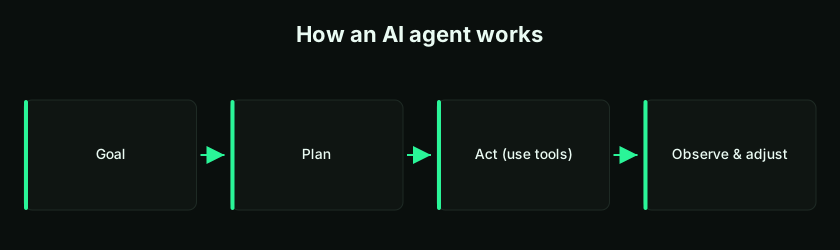
You don't need to understand the internals to use an agent, but a simple mental model helps. Most agents follow a loop:
- Goal. You give it an objective in plain language — for example, "sort incoming support emails and draft replies to the simple ones."
- Plan. The agent breaks the goal into steps: read each email, judge how urgent it is, decide whether it can answer, and draft a reply if so.
- Act. It uses tools to carry out those steps — opening the inbox, reading messages, writing drafts, and sorting them.
- Observe and adjust. It checks the result of each step and adapts — escalating anything complex to a human instead of guessing.
The "act" part is what sets agents apart: they connect to real tools like email, spreadsheets, chat apps, databases, and APIs to actually change something in the world, not just describe it.
What AI Agents Are Made Of
Under the hood, most agents combine a few building blocks — described here in everyday terms:
- A goal or role. What the agent is meant to achieve, e.g. "qualify new sales leads."
- Triggers and inputs. What starts it — a new email, a form submission, a scheduled time, or a button.
- Reasoning. The AI "brain" that decides what to do at each step.
- Tools and integrations. Connections to the apps it works with — a CRM, Google Sheets, Slack, email, a database.
- Guardrails. Limits on what it's allowed to do, and when it must hand off to a human.
Modern platforms let you assemble these using visual builders and plain-English instructions, which is why non-technical people can now create agents that once required a development team.
Real Examples of AI Agents at Work
Agents are most useful for repetitive, rule-based tasks that used to eat up human time. A few common examples:
- Support triage. Read incoming support emails, sort them by urgency, answer the simple ones from a knowledge base, and route complex issues to a person.
- Lead qualification. Check new leads against your criteria, enrich them with public information, and assign them to the right salesperson.
- Email management. Categorize inbound messages, draft replies, and route them to the right team member.
- Content drafting. Research a topic, draft an article or social post, and prepare it for review.
- Data entry and summaries. Pull data from documents, enter it into a system, and produce a clean summary.
The pattern is always the same: the agent handles the routine steps, and a human stays in charge of judgment and exceptions. See more in AI agent use cases for small business.
Where Do "Agentic AI" and "AI Agents" Fit Together?
You'll often hear the phrase agentic AI alongside AI agents. The simplest way to think about it: an AI agent usually handles one well-defined task, while agentic AI is the broader capability of planning, reasoning, and coordinating several agents and tools to achieve a bigger goal. One agent drafts the reply; agentic AI orchestrates a whole workflow. We unpack this fully in agentic AI vs AI agents.
Can Non-Technical People Really Use AI Agents?
Yes — this is the big shift. Modern no-code platforms let you build and use agents through visual interfaces and plain-language instructions, with pre-built templates and one-click connections to the tools you already use. You describe the goal, choose what triggers the agent, connect it to your apps, and set limits. A basic agent can often be up and running in well under an hour, compared with the weeks that custom development used to take.
The most successful beginners share one habit: they start with a single, specific task rather than trying to automate everything at once. Narrow scope with clear boundaries is the recipe that works. Our guide on building an AI agent without coding walks through the steps.
A Balanced Note: Agents Need Oversight
AI agents are powerful, but they're not infallible. They can produce confident-sounding answers that are wrong, lose track of context in long tasks, and occasionally take an action that looks reasonable but is incorrect in your specific situation. That's why every serious agent should signal uncertainty, stay within clear limits, and hand off to a human for anything sensitive. Treat an agent as a fast, capable assistant that still needs supervision — especially where money, customer data, or compliance is involved. We cover this honestly in can you trust AI agents?
How This Connects to Building Apps
AI agents and AI app builders are closely related. An idea-to-app platform like LogicMint lets you generate working apps from plain-English descriptions, and agents can live inside those apps — drafting content, summarizing records, or driving a workflow. On the LogicMint marketplace, creators even package and sell ready-made agents and templates. So understanding agents isn't just theory; it's a practical building block for the software you can create today.
Key takeaways
- An AI agent takes a goal, plans steps, uses tools, and acts — it doesn't just answer like a chatbot.
- Agents follow a loop: goal → plan → act → observe and adjust, connecting to real tools like email, CRMs, and databases.
- They shine at repetitive, rule-based tasks — support triage, lead qualification, email, data entry, drafting.
- Non-technical people can now build agents with no code — start with one specific task.
- Agents need oversight: clear limits and a human in the loop for anything sensitive.
Frequently Asked Questions
What is an AI agent in simple terms?
An AI agent is software that takes a goal, decides the steps to reach it, uses tools to act, and completes a task — often with little supervision. Unlike a chatbot that only answers questions, an agent takes action.
What is the difference between an AI agent and a chatbot?
A chatbot responds to a single question with information. An AI agent pursues a goal across multiple steps, uses other tools, and produces a real result — for example, drafting and filing replies rather than just telling you how to reply.
Can non-technical people use AI agents?
Yes. No-code platforms let you build and use agents through visual interfaces and plain-language instructions, with templates and one-click integrations. A basic agent can be set up in under an hour.
What can AI agents actually do?
Common uses include support-email triage, lead qualification, email management, content drafting, and data entry with summaries — routine, rule-based tasks where a human stays in charge of judgment and exceptions.
Are AI agents safe to trust?
Agents are useful but not infallible. They can be confidently wrong or lose context, so they should signal uncertainty, stay within clear limits, and hand off to a human for sensitive tasks involving money, customer data, or compliance.
What is the difference between AI agents and agentic AI?
An AI agent usually handles one well-defined task. Agentic AI is the broader capability of planning and coordinating multiple agents and tools to achieve a larger, multi-step goal.
AI agents mark a shift from AI that talks to AI that does — software that can take a goal and carry it out using real tools. For non-technical people, that means you can now automate routine work and even embed agents inside the apps you build, as long as you keep clear limits and a human in the loop. To see how agents and apps come together, explore LogicMint, browse the marketplace, or start with agentic AI vs AI agents.