AI Agents vs Chatbots vs Automation (RPA): Which Do You Actually Need?
Chatbots, traditional automation, and AI agents get lumped together, but they solve different problems. A chatbot talks. Automation follows fixed rules. An AI agent makes decisions and acts. This guide explains the difference in plain language and gives you a simple framework to choose.
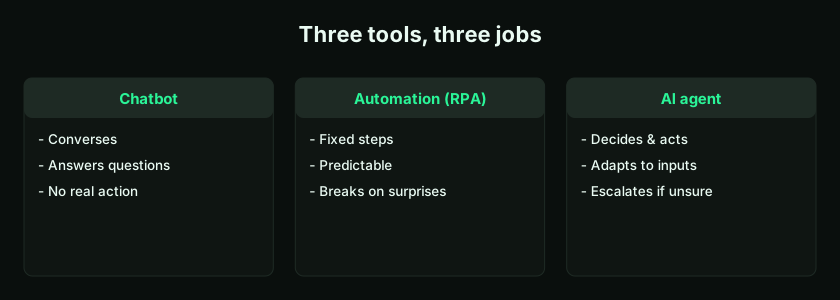
The Three in One Sentence Each
- Chatbot: answers questions and holds a conversation.
- Automation (RPA/workflow): runs a fixed sequence of steps exactly as programmed, every time.
- AI agent: takes a goal, decides what to do, uses tools, and adapts along the way.
The key differences are conversation vs action, and fixed rules vs decision-making. (For the agent basics, see what are AI agents?)
Side-by-Side Comparison
| Dimension | Chatbot | Automation (RPA) | AI agent |
|---|---|---|---|
| Core job | Converse and answer | Execute fixed steps | Achieve a goal |
| Flexibility | Responds to language | Rigid, rule-based | Decides and adapts |
| Handles the unexpected | Limited | Breaks or stops | Adjusts or escalates |
| Takes real action | Usually no | Yes, but only scripted | Yes, and chooses which |
| Best for | Q&A, support chat | Predictable, repetitive flows | Judgment-based, variable tasks |
What a Chatbot Is (and Isn't)
A chatbot is built for conversation — answering FAQs, guiding a user, collecting information through dialogue. Modern AI chatbots are fluent and helpful, but a pure chatbot's job ends at the reply. It typically doesn't reach into your systems to change something. If your need is "help a visitor get an answer," a chatbot fits. If your need is "get a task done," you want more.
What Traditional Automation (RPA) Is
Automation — including RPA (robotic process automation) and workflow tools — executes a fixed sequence of steps precisely and tirelessly. Move data from a form to a spreadsheet, send a templated email when a box is ticked, copy records between systems: automation excels when the process is predictable and unchanging. Its strength is reliability. Its weakness is rigidity — when something unexpected happens, rule-based automation tends to break or stop, because it can't decide what to do outside its script.
What an AI Agent Adds
An AI agent brings judgment to automation. Instead of following a fixed script, it takes a goal, decides the steps, uses tools, and adapts when inputs vary — escalating to a human when it's unsure. Where automation asks "what are the exact steps?", an agent asks "what's the outcome, and how do I get there given what I'm seeing?" That makes agents suited to tasks that are repetitive but variable — like triaging messages that don't all look the same, or qualifying leads that don't arrive in a fixed format. Combine several and coordinate them, and you get agentic AI.
They Often Work Together
This isn't strictly either/or. Real solutions frequently blend all three: a chatbot collects a request in conversation, an agent decides how to handle it, and automation carries out the predictable steps once the decision is made. Think of automation as the reliable hands, the agent as the decision-making brain, and the chatbot as the friendly front desk. The best design uses each for what it does well.
A Simple Framework to Choose
| If your need is… | Reach for… |
|---|---|
| Answering questions or guiding users in conversation | A chatbot |
| A fixed, predictable process that never varies | Automation / RPA |
| A repetitive task that varies and needs judgment | An AI agent |
| A multi-step process spanning systems with decisions along the way | Agentic AI (coordinated agents) |
A quick test: if you can write down every step in advance and they never change, automation is simpler and more reliable. If the task requires deciding which step based on what's happening, you want an agent.
What This Means for Non-Technical Users
You don't have to pick a camp or learn to code. No-code platforms let you build chatbots, automations, and agents — and often combine them. The practical advice is the same across all three: start with one clear task, define it precisely, connect only the tools it needs, and keep a human in the loop for anything sensitive. For agents specifically, our step-by-step is in how to build an AI agent without coding, and the trust considerations are in can you trust AI agents?
Bringing It Into Your Apps
All three can live inside the software you build. With an idea-to-app platform like LogicMint you can generate an app, add a chatbot for user questions, wire up automations for predictable flows with the business automation builder, and embed agents for the judgment-based parts. You can also start from ready-made templates and agents on the marketplace.
Key takeaways
- Chatbots converse, automation executes fixed steps, AI agents decide and act.
- Automation is best when a process is predictable and unchanging; it breaks on the unexpected.
- AI agents fit tasks that are repetitive but variable and need judgment.
- They often work together — chatbot as front desk, agent as brain, automation as hands.
- Choose by asking: can I script every step in advance (automation) or must the tool decide as it goes (agent)?
Frequently Asked Questions
What is the difference between an AI agent and a chatbot?
A chatbot answers questions and holds a conversation. An AI agent takes a goal, decides what to do, uses tools, and takes action — it does tasks rather than just talking about them.
What is the difference between an AI agent and automation (RPA)?
Automation runs a fixed sequence of steps exactly as programmed and breaks when something unexpected happens. An AI agent makes decisions and adapts to variable inputs, escalating to a human when unsure.
Which is better, automation or AI agents?
Neither is universally better. Automation is simpler and more reliable for predictable, unchanging processes. AI agents are better for repetitive tasks that vary and require judgment.
Can chatbots, automation, and AI agents work together?
Yes. A common design uses a chatbot to gather a request, an agent to decide how to handle it, and automation to carry out the predictable steps — each doing what it does best.
How do I choose which one I need?
If you can script every step in advance and they never change, use automation. If the task needs deciding which step based on what's happening, use an AI agent. If you just need to answer questions, use a chatbot.
Do I need coding to use these?
No. No-code platforms let you build chatbots, automations, and agents — and combine them — through visual tools and plain-language instructions.
Chatbots, automation, and AI agents aren't competitors so much as different tools for different jobs: conversation, fixed execution, and judgment-based action. Match the tool to the task — and combine them when it helps. To build any of the three into real apps without code, explore LogicMint, browse the marketplace, or read agentic AI vs AI agents.